Saturday, July 19, 2014

Book 55- Petersburg

I thought I liked Russian literature, but with the last few novels I have read I have been proved wrong. It turns out I like a very specific era of Russian novels, or perhaps just two Russian authors: Dostoyevsky and Tolstoy. With the Russian novels on the Novel 100 list I have been highly disappointed. One of my friends sent me a highly amusing summary of Russian novels that is worth a read. I recognized quite a few novels on the list! It is interesting to point out that Petersburg by Andrei Bely is one of about 10 novels that does not also appear in the 1001 Books list that I am also reading.

One good thing about the list is that I am starting to draw parallels between the novels I have read and I found a few with this novel. The strongest correlation I found in this novel was to Fathers and Sons by Turgenev. The two main characters Abluekhov and Nikolai are at war with one another just like the father and son duo from Turgenev's novel.  I didn't like that novel either.  There was a Russian symbolist movement? Who knew. This novel also has a few comparisons to Ulysses and  James Joyce. In my mind, there is no comparison between the two, although this novel precedes Ulysses by nearly a decade. Having recently read Grapes of Wrath I also found elements of the weird poetic breakouts from that novel in this one. I didn't like those elements in Grapes of Wrath either. Generally, I like symbolism, and I imagine I am one of the few people who truly like Joyce. The movement loses something when you try to place it in the Russian context. All my favourite elements of Russian novels (the focus on the poor, the focus on the human condition, and a connection to the environment around you) get lost in this novel. The final novel I was reminded of, mostly because of the use of a bomb in the novel, was The Secret Agent by Joseph Conrad.

I spent a large portion of my time reading this novel completely confused. It jumped around in time and and from several points of view. It retold incidents from several angles. I would eventually figure out what was happening, but not before floundering around helplessly. The one thing that this novel had going for it  is that it had elements of a nightmarish dream world. Reality and dream were intermingled in it and the feeling I was left with was one of impending doom. None of the characters in the novel are having a good time in life and we are viewing the world through their eyes. This leaves everything with a distorted feel to it. I don't think there is a single neutral narrator in the novel. They are all unreliable.

I am grateful to leave this novel behind and will probably not think of it again. I am still left mulling over Grapes of Wrath, however. Although I didn't love the entire novel it had a lot of really great things to say and I am constantly reminded of it when I think of the world today and the disconnect between the rich and the poor.

Friday, July 4, 2014

Book 54- Grapes of Wrath (87th Book)

I was so excited to read book 54- The Grapes of Wrath. John Steinbeck was one of my favourite authors as a teen. I devoured several of his books including East of Eden, Winter of our Discontent and several of his short stories before crashing and burning on his novels. I made the early discovery, which I made several times in my teens...if you read too much of the same author     you are struck with the fact that they really only have one main theme and all the books start to blur together.

This is one of Steinbeck's best sellers but it is by no means my favourite.  The first novel I ever read of his was East of Eden and it will always be my favourite. I love the angst in that novel and connection to the land and the deep things inside of each person. The Grapes of Wrath is great and I can see why it became a classic. I was silently filled with horror as I read the novel and completely uncomfortable the whole time I was reading. Why? I thought it foreshadowed a little too much about the direction we a going as a society.

I have always been a bit of a rebel and held very disparate views. While being a conservative in my faith, I am a bit of a radical in my political views. The novel tracks the Joad family as they travel west after losing their farm to the bank. The trip West shows a growing discontent in the poor population as they scramble for food, shelter and an identity for their family. The novel goes behind the sense to the political forces at play in time of the Great Depression. The farms out west need a few hundred workers, but send out a few thousand flyers, knowing that if too many workers arrive the price of labour will go down. It sounds eerily like what is happening in British Columbia right now. With the teachers strike happening I have had several conversations with others and the theme always seems to go something like this, " those damn teachers! Why do they think they deserve more money than me?" to which I invariably reply, " they don't, but they are willing to fight for their rights." I had a similar conversation with a friend when the minimum wage was increased. She works at a job which she has been at for 10 years and who valued her slight raises over the years. She was annoyed that now others would be able to have a wage that was dangerously close to hers. Rather than try to press her employer for a greater raise in light of the increase she was frustrated at the poor who we're trying to rise.

Poverty does horrible things to people and this novel shows the damage from both sides. The wounds to dignity inflicted on the poor are doubled by the fact that the wealthy direct their hatred and fear  towards those less fortunate. This cycle creates what the novel refers to as the "grapes of wrath". One of my favourite novels of Steinbeck, Cannery Row,  has a quote that I absolutely love:

 "It has always seemed strange to me...the things we admire in men, kindness and generosity, openness, honesty, understanding and feeling, are the concomitants of failure in our system. And those traits we detest, sharpness, greed, acquisitiveness, meanness, egotism and self-interest' are the traits of success. And while men admire the quality of the first they love the produce of the second."
That quote  is mirrored throughout the novel The Grapes of Wrath. The novel shows that the Joad family are willing to help others despite their limited means. The people they interact with on the road and in the Hoovervilles behave like family and lend a helping hand whenever they see a need. I have always felt that when I interact with poor. On my way home I pass a panhandler every day and he always has a smile on his face. Although he rarely gets money from the passersby he greets me everyday with " have a good day, dear". He warms my heart. When the Joad's cross a picket line and find themselves in a camp with a store that is overpriced Ma finds it is the equally as poor clerk who reaches out to her. She utters a quote that rings true to me " if you're in trouble or hurt or need- go to the poor people. They're the only ones that'll help- the only ones". Rich people have a reputation for being stingy. It's a sad but true fact.

This novel was an adventure for me. Everything within me made me want to fling the book across the room in anger and disgust. It was like staring at a very bad car accident or a horrible act of cruelty. History repeats itself they say... And I am scared that The Grapes of Wrath is foreshadowing of the worst kind. We have seen half hearted attempts in the 1% movement, but God help us if the poor ever do get frustrated with the way things are going. There is power in numbers when mass amounts of people are angry and it seems to me that the wealthy have oppressed the poor (and even middle class) for too long.

The Grapes of Wrath is a political novel. It will never be my favourite Steinbeck creation, but it is a masterpiece that sadly needed to be written. It moved me in a way that only a great novel can. I was sad, angry and horrified and yet kept reading. Like life, the novel really doesn't have a resolution but it seems appropriate given the content. I would be curious to know what others reactions were to the novel since my reactions were so strong.

Monday, May 19, 2014

Alice in Wonderland (86th Book)

Ah, Alice in Wonderland a story that everyone knows, but few have read. I fell into that category until very recently when I quickly finished my book for the Novel 100 challenge and wanted to read a book from the 1001 Books challenge. I am starting to get grumpy about my fiction though and I didn't want to read anything that would be as slog. I was also lazy and needed to find either something I had on my Kobo or something I had on my shelf. I chose to read Alice in Wonderland, because I knew it would be a joy to read and I wasn't wrong!

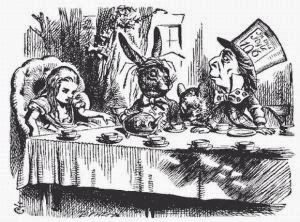
I don't think I have ever read Alice in Wonderland even though I, like the rest of western civilization, know the story by heart. I read the book on my Kobo and was very sad that the images were listed, but did not appear. I love the original artwork from this book and used several of the images to make jewellery when I was on a kick of making scrabble tile necklaces. Lewis Carroll does a good job of describing the life of a young child. His depiction of Alice prior to her tumble down the rabbit hole reminds me of every toddler I have ever known including myself. Kids are easily bored and have trouble sitting still. They also have vivid imaginations and Alice's "dream" is full of wonderful imagery and fantastical occurrences. I still remember when I started to fell weird about engaging in imaginary play. The transition from child to teen is so hard.


When I googled Alice in Wonderland to find an image to include in my blog the book covers and pictures didn't even appear as an option. The categories included Disney, Tim Burton and the various movie images, but not a single book cover. I find that sad. Don't get me wrong, the movies have made Alice in Wonderland available to the masses, but there is just something amazing about reading something in its original form.  I do, however have a favourite adaptation of Alice and that is the Scy Fy Channel's made for TV Mini Series: Alice. The Mad Hatter, or Hatter, is fantastic in the show and the depiction of Wonderland as a casino where people feed on human emotions is both creepy and fantastic.

I can't wait to read Through the Looking Glass which is also on the 1001 Books to Read list. I am not sure I know much about that story and have been enjoying the books on the list that make up great story telling. I can see why Alice in Wonderland has been pasted down for generations and also why there are have been so many remakes of the books and movies. It is a tale that has definitely stood the test of time!

Book 53- Red Badge of Courage (85th Book)

Those who know me personally, know I have a trauma reaction to war. I am particularly traumatized by anything First World War-ish. The thought of trench warfare sends me cringing into a corner, rocking back and forth on my heels. I once had a friend who caused me to collapse in a heap in a drama game simply by whispering things about a war scene from Legends of the Fall. Remembrance Day is a hated holiday for me and I avoid war movies like the plague. So, needless to say, it is was with great trepidation that I picked up Book 53-The Red Badge of Courage. I was just stubborn enough with this challenge to push past my fear and read this extremely short novel about the American Civil War. I was pleasantly surprised. As much as I hate war I love novels of development and this definitely fits the Bildungsroman category.

The novel follows Henry Fleming as he sets out for his first real taste of war. He starts out idealistic and hopeful, but then runs in terror when he first encounters battle. Although he eventually goes back and finds his troop, he has to live with his initial desertion through the rest of the novel. He struggles with how to assimilate his cowardice with the idea he has of himself and it makes for a very poignant novel. Henry is a very relatable character who I felt for very much. He is real and honest and his struggle to live with himself in the wake of his desertion is absolutely touching.  The descriptions of war are horrific, but are off set by a large amount of internal dialogue. It is as much a critique of war as it is a critique of the unrealistic standards we hold up for ourselves.

I loved when I discovered that the phrase "Red Badge of Courage" was a description of wounds. In the novel this refers not only to physical wounds, but I also believe it refers to the more permanent emotional wounds that we carry around with us. Although Henry might have been cowardly for running away, he is courageous for coming up with a way to live with himself in the face of personal disappointment. "A moral vindication was regarded by the youth as a very important thing. Without salve, he could not, he thought, wear the sore badge of his dishonour through life."

This novel deserves a place in history as a classic novel because it was able to bring something hated and distance from me into the forefront of mind in very real way. I have loved this Novel 100 challenge for the simple reason that it has pushed me to read things I would have otherwise avoided. The next novel has been on my to-do list for years. John Steinbeck is one of my favourite novels and I am very excited to read Book 54-Grapes of Wrath next.

Sunday, May 4, 2014

Book 52- Jane Eyre (84th Book)

It seems I was badly mistaken. For years I have railed against the likes of the Bronte sister's and Jane Austen. I have staunchly refused to read anything that smacked of cheesy romance....the closest I got as a teen was Wuthering Heights. All the other "classic" novels that my friends read were lumped into the fluffy romance category that somehow  managed to be passed off as classic literature. I was sorely mistaken about Jane Eyre. While Jane Eyre IS a romance novel it is also falls into a category of fiction that I have recently discovered I love: Gothic fiction.

Gothic fiction pulls off a mood of eeriness that is very rarely accomplished in modern day horror. The use of lightening and remote locations and forlorn situations are tied together in such a way that suspense is added to a simple situation that would otherwise be quite normal. I have recently read Uncle Silas and Rebecca. Here is my simple breakdown of what makes a novel Gothic given the small sample I have read.


  • A life situation that makes one lonely and vulnerable (widow-Rebecca, orphan- Jane Eyre and the Uncle Silas)
  • A remote location (a forlorn house-Rebecca,Uncle Silas, Jane Eyre)
  • A mystery (Uncle Silas-Uncle Silas, the mystery woman-Jane Eyre, and Rebecca- Rebecca)
  • A strong constitution that allows the main character to face difficult situations (Mrs. De Winter, Jane Eyre, Maud Ruthyn)
  • Horrible caretakers that make the characters lives miserable (Uncle Silas and Madame de le Rougierre- Uncle Silas, Mrs. Reed- Jane Eyre, Mrs. Van Hooper-Rebecca)


I love  mysteries, I love psychological suspense, I love strong heroines, I love rambling old houses. What's not to love about gothic mysteries!? It just goes to show that you can't judge a book by its cover and you can't judge a story by the category that you lump it into. I was thoroughly engaged with the story of Jane Eyre and desperately wanted to know what was going to happen. The novel has all the elements of good story telling and a suspense that makes it a page turner.

One thing that makes me extremely uncomfortable about the love story in Jane Eyre is the age difference of Jane Eyre and Mr Rochester. I teach about age of consent and Sexual Exploitation as part of my job and I just can't get over the fact that very little concern is brought up about the age difference in this story. On the plus side, the novel is not glorifying two beautiful people who just so happen to find each other across the distances. It is a love story for your average individual. I don't think you would find a true-to-novel hollywood version of this story since both the characters are described as having very little going for them in the looks department. In fact, I just googled Jane Eyre to see the movie versions of the novel and found that the movies are filled with beautiful people.

I can be a bit of a snob when it comes to novels. I like my books to have a point and I like to feel enlightened when I read them. Nothing, however, will ever take the place of a just plain good story. I suppose for that reason Jane Eyre deserves a place in history.

Tuesday, March 25, 2014

Uncle Silas (83rd Book)

I decided to read a themed book for my 1001 Book this month. Since Saint Patrick's Day falls in March I chose to read a novel by an Irish author. I could have chosen James Joyce, of course, but as much as I love his novels (and I really do) they hurt my head. I took a look through the 1001 Novels to Read Before You Die book and stumbled upon Uncle Silas by Sheridan Le Fanu. I had never heard of this author before, but the novel peaked my interest with its description of mystery and investigation surrounding an old house and a young heiress. I was not disappointed.

The novel follows Maud Ruthyn who is orphaned at the age of 16 or 17. Upon her father's death, she is sent to her Uncle Silas, whose life has always been surrounded by mystery, until she turns of age. While her father is still alive she finds out that her uncle was once accused of murder and his name was never cleared of the charge. He has lived as a hermit ever since. Before her father's death he asked if she would help to clear her uncle's name even though it may be a trial for her. She heartily agreed and the way she was to clear his name was revealed in the will.

As much as  I love this novel there is one thing that confused me. It was never really made clear whether her father was aware that her Uncle had never changed. I am assuming since he sent his daughter to live with him that he did not. To me Uncle Silas always seemed a bit mysterious and the father's blind trust in his brother seems a bit contrived.

The rest of the plot had me riveted. I was desperate to know what the outcome of the novel would be and sped through the book at a quick pace. Although the book was written in the late 1800's it has all the classic mystery/ horror features we have grown to love over the years: a family with a secret, a run down house that has seen better days, a physically creepy relative shrouded in mystery and a helpless girl with no one to care for her. The novel reminded me of Rebecca which has several similar elements included a mysterious relative, a murder in the past, and a rambling old house. I liked both of these novels and I am a fan of the genre. This novel has been likened to the novels of Wilkie Collins and I am very excited to read The Women in White when it appears on the Novel 100 list as I thoroughly loved The Moonstone.

It has been a long time since I have been sad when a novel has ended, but I felt that way when I finished Uncle Silas. I am at loose ends to know what to start next before April arrives and I can start my novel 100 book for the month, Jane Eyre. In keeping with reading themed books off the 1001 Books list I may read one of the novels focused on the life of Jesus for Easter. I have found two on the list so far and will have to make a trip to the library to pick one up if I decided to do it.

Saturday, March 22, 2014

Book 51- The Trial (82 Book)

I read The Trial by Franz Kafka quite quickly. I was definitely engaged and interested in the material and I loved the sense of incomprehension and mystery that the novel presented. It seemed like a great allegory for the existential angst and guilt that we all face as humans and as I have expressed before, I love that stuff! This novel is gripping and engaging and it has been a long time since I have been able to say that about one of the books on the list.

Josef K. is a man who wakes up one morning only to discover that he is under arrest. Having no recollection of a crime, and being completely incomprehensible of the legal system he is ensnared in he limps along trying his best to live his life while he is under a trial of guilt. The novel progresses to his eventual execution at the hands of others and the reader is left wondering whether it might not be true that we are all guilty.

There are a lot of allusions to the Christian idea that we will all be tried and judged at the end of our life. "the final judgement can often come without warning, from anyone at any time". There is a reference made at one point by a lawyer who points out that the only way to escape these trials is to admit your guilt. There is also another reference to the fact that this trial is ongoing and that there will be no end. The book leaves you with the eerie feeling that you have felt the things Josef feels before and that as confused as the novel (and Josef K. ) is that there is something familiar about the whole process.

There are several references to the fact that the accused are still human beings and still beautiful even in their guilt. I love that! I have always been a big fan of human dignity and treating the worst offender with respect. "How is it even possible for someone to be guilty. We're all human beings here, one like the other." Even though we are all "guilty" in different ways (some more appalling in our eyes than others) we are all bound together by the same fate. "If, in spite of that, you're are still a gentleman then I'm just as much a gentlemen as you are" I love that on the show Doctor Who the Doctor makes frequent references to how amazing humans are. Even though his character is always rescuing humans from a horrible fate we caused ourselves, he finds us beautiful in our ability to be creative and amazing. I think that is how God thinks of us too. "If you look at them the right way the accused really can be attractive quite often".

There was also a beautiful metaphor used in the book about a man trying to enter the gates of heaven. It talks about how the gate was only for him, but the gate keeper wouldn't let him in. The man stood outside asking the gate keeper every now and again for entrance, but was frequently denied. It isn't until the end of the life that the gate is closed. Although we are all tied together by the common fate of existential guilt and anxiety. We are also alone in our "Trial". We are the only one that can walk the path set out before us and that can be a lonely feeling. We can receive help from others, but we must walk the path ourself. There is a great quote from a Mumford and Son's song that expresses this idea so well. I have always loved it. "As brothers we will stand and we'll hold your hand...but I can't move the mountains for you". The final thing the gatekeeper tells the man trying to enter heaven is "Nobody else could have got in this way, as this entrance was meant only for you. Now I'll go and close it". The man waited at the gate instead of living his life. In the end he faced remorse. The last few lines of the book, as Josef K. faces his accuses, are absolutely beautiful. I think he expresses the greatest human fear about death. Both the fear of death itself, as well as the fear of being found wanting in the end. "I always wanted to snatch at the world with twenty hands...Are people to say of me after I am gone that at the beginning of my case I wanted to finish it, and at the end I wanted to begin again? I don't want that to be said."