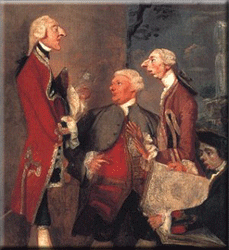
I liked book 36- Le Pere Goriot. It feels good to say that. I have felt like a book snob in the last few review since I just haven't fallen in love with any of them. What makes this even sweeter is that Le Pere Goriot is a French novel and I haven't liked the last few French novels I have read. This book focused on the poor class rather than the wealthy though and for that reason I enjoyed it quite a bit. It is set in a French rooming house run by Madame Vaquer, a lady who is herself down on her luck. The story centres around two central characters the poor Rastignac and the doting father, Le Pere Goriot. It is the encounter between these two that shows the effects of poverty working out in the lives of two very different people.
I think it is the books refusal to candy coat the wickedness of society or of humanity that makes me like this book. It is very much reminiscent of Russian novels to me in that way. It is a book to me, that feels like real life. I didn't feel enlightened by any deep insights into humanity with this novel, but I was thoroughly engaged in the story and I finished it quickly.
Here are a few of the insights the book makes about the dark side of life.
"mankind are not perfect"
"man is not the same, high or low, or wherever he is"
"Everyone believes in virtue but who is virtuous"
"Indifference to the fate of others is a matter of course in this selfish world"
One of the most interesting portrayals in the book is Le Pere Goriot. He is a father that is doggedly devoted to his daughters and his love destroys both himself and his daughters. It is the clearest example of codependency I have ever seen. This psychological problem was most clearly shown to me in my first job out of university where I worked at a Christian women's home for a few months. After completing a psychology degree, but feeling very unskilled I was happy to have a job in the field even though it was not well paid. One woman there struggled with codependency and it came out in all sorts of ways. She told me one day, how she had ended up in the home and it was as a result of giving all her money to a aboriginal tribe who was trying to buy a historical site and ending up homeless herself. Goriot is not far off this real life example. Although being generous is a good thing, giving at the expense of yourself to the point of ruin is both pointless and unattractive. For those who have struggled in life, finding an identity as a helper can be a crutch that is relied on too heavily in all kinds of troubles. This is where it becomes problematic.
Although it is not my favorite book of all time, it is certainly a worthy read, and a find I am happy to say I stumbled upon as a result of reading the books on the Novel 100 list. It has given me determination to continue to read the books on the list in hopes of discovering more enjoyable reads I would have never picked up on my own.
Saturday, January 5, 2013
Saturday, December 15, 2012
Book 35-Buddenbrooks (49th book)
The 35th Book on the list was Buddenbrooks by Thomas Mann. I was excited to read it because I quite liked Magic Mountain by Thomas Mann. This book, however, was not as good as Magic Mountain. Although I found the story engaging. I was not touched by it on a human level. It was a good story but that was about all it was.
The story follows the family Buddenbrooks throughout the generations as the family name and inheritance is slowly whittled away over time. The first Patriarch Johann is the epitome of practical while the last heir Hanno is the epitome of the artistic. Neither one of these individuals could have existed without the other. The novel as one of the buildungsroman genre shows that a healthy inner life is equally as important as a strong external life.
My favorite character was Tony who tried so hard to live well for the sake of the family name. Each of her successive marriages and the marriage of her daughter end badly for her and she is unable to realize the ideal of contributing to the family name that she so badly desires. She was the most realistically portrayed character for me. Tony really believed that "we are not separate, independent, self subsisting indviduals, but links in a chain". She gave up her childhood love for a marriage that she believed would be an honour to her family. She constantly referred to this stage of her life as her being a "silly goose".
There are some interesting themes in the book that seem reflected by the last line of the novel which is uttered by Sesame Weichbrodt in response to Tony's comment that, " God strike me , but sometimes I doubt that there is any justice, any goodness, I doubt it all. Life, you see crushes us, it shatters our faith. See them again, if only it were so"
Sesame, who has educated generations of Buddenbrooks still holds out hope that "It is so".
Although the book is a novel about the decline of a family. It appears to hold out hope that even though things get bad that there is something worth living for. It looks at life realistically in that it might not always be easy or good but that it is worth it nonetheless.
Here are some quotes I liked
"I've always been of the opinion that all men are equal and that we don't need any middlemen between us and our God"
"What is success? ...the belief that life can be molded to my advantage"
"...responded in one way in his strong and optimistic moments, and another when he was weary...he was a mixture of both"
"A happy, present is not something we can always take for granted."
The story follows the family Buddenbrooks throughout the generations as the family name and inheritance is slowly whittled away over time. The first Patriarch Johann is the epitome of practical while the last heir Hanno is the epitome of the artistic. Neither one of these individuals could have existed without the other. The novel as one of the buildungsroman genre shows that a healthy inner life is equally as important as a strong external life.
My favorite character was Tony who tried so hard to live well for the sake of the family name. Each of her successive marriages and the marriage of her daughter end badly for her and she is unable to realize the ideal of contributing to the family name that she so badly desires. She was the most realistically portrayed character for me. Tony really believed that "we are not separate, independent, self subsisting indviduals, but links in a chain". She gave up her childhood love for a marriage that she believed would be an honour to her family. She constantly referred to this stage of her life as her being a "silly goose".
There are some interesting themes in the book that seem reflected by the last line of the novel which is uttered by Sesame Weichbrodt in response to Tony's comment that, " God strike me , but sometimes I doubt that there is any justice, any goodness, I doubt it all. Life, you see crushes us, it shatters our faith. See them again, if only it were so"
Sesame, who has educated generations of Buddenbrooks still holds out hope that "It is so".
Although the book is a novel about the decline of a family. It appears to hold out hope that even though things get bad that there is something worth living for. It looks at life realistically in that it might not always be easy or good but that it is worth it nonetheless.
Here are some quotes I liked
"I've always been of the opinion that all men are equal and that we don't need any middlemen between us and our God"
"What is success? ...the belief that life can be molded to my advantage"
"...responded in one way in his strong and optimistic moments, and another when he was weary...he was a mixture of both"
"A happy, present is not something we can always take for granted."
Sunday, November 4, 2012
Book 34 Tess of D'Urbervilles (48th Book)
Well, here it goes, my review of Tess of D'Urbervilles (book 34 on the list). I have been hesitant to do this review because I had a fairly significant meltdown while reading this book. Despite deeply connecting to the book, I still can't say that I loved it. I have lately been ruing my choice to start at the top of the list and work my way down. I have developed a bit of a snobbish taste for literature now despite not even liking some of the top ten on the list. I fear the closer to the bottom I get the more dissatisfaction I will feel.
The book chronicles Tess, a poor girl from a family with a significant historic name. In a time of financial stress her family turns to a supposed relative bearing the D'Urberville name. When the son, Alec seduces her and she finds herself pregnant. She returns home only to have the baby die. When the family falls into financial hardship again Tess becomes a dairymaid in a farm several miles from homes. Here she meets Angel Clare who woos her despite Tess's repeated protests that she is not worthy of him.She repeatedly tries to convey her shame and downfall to Angel who refuses to listen to her, having firmly placed her on a pedestal She eventually consents to marriage and slips a note under his door telling him of her former fate. Unfortunately, it slides under a carpet and goes unread. She doesn't discover this until their wedding day and Angel finally consents to have a heart to heart about each of their follies on their wedding night after they are married. While he reveals his sins and is forgiven he turns against Tess when he discovers hers and leaves having never consummated their marriage.
It is here where I had my meltdown. I am in a fairly new relationship and as I read this book one gloomy/ cozy Saturday I was simultaneously angry and contemplative. I was furious with Angel and his off-handed refusal to see Tess for who she really is. I was also furious that he judged Tess for her actions in the past rather than her heart that he had fallen in love with. This got me all in a tizzy about how one can know that you are REALLY seeing someone for who they are and not just the idealized image of that person you have created in your mind. I thought long and hard about whether that could happen to me and concluded that it very well could. I have always been someone who places people on a pedestal only to have them later fall when they can't live up to my idolized version of them. The book led to a fairly significant internal inventory of my current relationship and also to an awesome heart to heart with my boyfriend about what we see in each other. I am thankful to the book for that, but feel that my epistemological crisis had very little to do with the point of the book which is about the sad state of affairs for women at the time and also Tess as a heroic character. I thought very little about Tess as a heroic figure as I read the book and just spent the majority of the time being horribly saddened by the fates that aligned against her.
Despite my half hearted enjoyment of the book I did find several awesome quotes that I loved:
"Tess was no insignificant creature to toy with and dismiss, but a woman living her precious life"
"I thought, Angel, that you loved me-me, my very self"
"Behold, when thy face is made bare, he that loved thee shall hate"
"In considering what Tess was not, he overlooked what she was"
I am on to book 35 which is Buddenbrooks now. As it is a translated novel I have had a hard time procuring a copy and ended up having to buy it on my ereader.
The book chronicles Tess, a poor girl from a family with a significant historic name. In a time of financial stress her family turns to a supposed relative bearing the D'Urberville name. When the son, Alec seduces her and she finds herself pregnant. She returns home only to have the baby die. When the family falls into financial hardship again Tess becomes a dairymaid in a farm several miles from homes. Here she meets Angel Clare who woos her despite Tess's repeated protests that she is not worthy of him.She repeatedly tries to convey her shame and downfall to Angel who refuses to listen to her, having firmly placed her on a pedestal She eventually consents to marriage and slips a note under his door telling him of her former fate. Unfortunately, it slides under a carpet and goes unread. She doesn't discover this until their wedding day and Angel finally consents to have a heart to heart about each of their follies on their wedding night after they are married. While he reveals his sins and is forgiven he turns against Tess when he discovers hers and leaves having never consummated their marriage.
It is here where I had my meltdown. I am in a fairly new relationship and as I read this book one gloomy/ cozy Saturday I was simultaneously angry and contemplative. I was furious with Angel and his off-handed refusal to see Tess for who she really is. I was also furious that he judged Tess for her actions in the past rather than her heart that he had fallen in love with. This got me all in a tizzy about how one can know that you are REALLY seeing someone for who they are and not just the idealized image of that person you have created in your mind. I thought long and hard about whether that could happen to me and concluded that it very well could. I have always been someone who places people on a pedestal only to have them later fall when they can't live up to my idolized version of them. The book led to a fairly significant internal inventory of my current relationship and also to an awesome heart to heart with my boyfriend about what we see in each other. I am thankful to the book for that, but feel that my epistemological crisis had very little to do with the point of the book which is about the sad state of affairs for women at the time and also Tess as a heroic character. I thought very little about Tess as a heroic figure as I read the book and just spent the majority of the time being horribly saddened by the fates that aligned against her.
Despite my half hearted enjoyment of the book I did find several awesome quotes that I loved:
"Tess was no insignificant creature to toy with and dismiss, but a woman living her precious life"
"I thought, Angel, that you loved me-me, my very self"
"Behold, when thy face is made bare, he that loved thee shall hate"
"In considering what Tess was not, he overlooked what she was"
I am on to book 35 which is Buddenbrooks now. As it is a translated novel I have had a hard time procuring a copy and ended up having to buy it on my ereader.
Saturday, September 29, 2012
Book 33-Dead Souls (47th book)
I have made a tactical error in working on the list of 100 novels. I started at the top of the list (aka the best of the best) and I am working my way down. Theoretically this means that the novels should get worse as the list goes, while still being the best of the best. This has held somewhat true, although there are quite a few of the highest rated novels on this list that I can't stand. I should have started at the bottom and worked my way up. I am starting to feel like a grouchy old reader who is difficult to impress. I WANTED to like book 33 Dead Souls by Nikolay Gogol because it is Russian, and Russian literature is my thing, but I just couldn't do it. It can't hold a candle to any of the other Russian novels that have charmed my fancy. Sigh.
Dead Souls IS rather Russian in that if follows a flawed character around on a scheme to buy up Russian souls. Unlike most other Russian characters though this one is not overly loveable in his flaws. I think this has a lot to do with the fact that the book is supposed to be a farce. I have discovered that despite loving to laugh I am definitely not a fan of farcical literature. (see my reviews on Tristram Shandy and Gravity's Rainbow). I like my literature to give me food for thought and put me into a contemplative mood where I analyze life. This book doesn't do that for me. I DID laugh several times at the oddity of buying up dead people.
Here are some quotes along those lines.
"But, sir, I have never in my life sold dead folk"
"The question is:what is a dead soul worth, and is it of any use to anyone"
"No matter what may be said to the contrary, the body can never dispense with the soul"
Despite being comical the book does pose some interesting philosophical questions that made me stop and think. I just wished there were more of them and that I CARED what happened to Chichikov as a flawed character moving about in the world. Most of the time I found him unbelievable and flat as a character.
"Take any man you like of the persons you term rascals. That man none the less remains a human being"
"Each of us commits faults with every step that we take; each of us entails unhappiness upon others with every breath that we draw"
"Human problems are difficult to solve"
So conclusion? Although being a fan of MOST Russian literature I am not a fan of ALL Russian literature. I will continue to read away on this list even though I am bound to find more duds. I am hopeful that that gems will make this little adventure worth it though.
Dead Souls IS rather Russian in that if follows a flawed character around on a scheme to buy up Russian souls. Unlike most other Russian characters though this one is not overly loveable in his flaws. I think this has a lot to do with the fact that the book is supposed to be a farce. I have discovered that despite loving to laugh I am definitely not a fan of farcical literature. (see my reviews on Tristram Shandy and Gravity's Rainbow). I like my literature to give me food for thought and put me into a contemplative mood where I analyze life. This book doesn't do that for me. I DID laugh several times at the oddity of buying up dead people.
Here are some quotes along those lines.
"But, sir, I have never in my life sold dead folk"
"The question is:what is a dead soul worth, and is it of any use to anyone"
"No matter what may be said to the contrary, the body can never dispense with the soul"
Despite being comical the book does pose some interesting philosophical questions that made me stop and think. I just wished there were more of them and that I CARED what happened to Chichikov as a flawed character moving about in the world. Most of the time I found him unbelievable and flat as a character.
"Take any man you like of the persons you term rascals. That man none the less remains a human being"
"Each of us commits faults with every step that we take; each of us entails unhappiness upon others with every breath that we draw"
"Human problems are difficult to solve"
So conclusion? Although being a fan of MOST Russian literature I am not a fan of ALL Russian literature. I will continue to read away on this list even though I am bound to find more duds. I am hopeful that that gems will make this little adventure worth it though.
Thursday, September 6, 2012
Love and Other Games of Chance- A Non list book
I picked up this book at Powell's in Oregon (the largest bookstore I've ever been to). It was on sale for $4.99 and the title intrigued me. As I read the inside cover it sounded like just my cup of tea. It involved magic, circus, love and a snakes and ladders game. It sounded like pure fun. I was not disappointed, but was pleasantly surprised that it was also philosophical which are my favourite kinds of books to read.
The first thing I loved about this book is that it involved Jewish circus performs. I love Russian literature for it's down to earth faith that permeates all aspects of life. This book portrayed Jewish life in the same way and I lapped up ever second page filled with great quotes. Here are some of them.
"As long as everyone remembers what he is supposed to remember , the word of our God, the creator of all will be kept alive"
"to be a Jew means to love words and stories"
"Every Jew is a character in a story that began with Abraham and has yet to end"
"Even though I do not believe in God, am beginning a story within a story"
"It made you want to take our religion seriously, to actually believe it is holy for a man and woman to love each other, and even to believe that we, men and women, really are created in the image of Elohim"
As a Christian grafted into the Jewish family as an adopted member, I have always LOVED the stories in the Old Testament. They speak so much of life and deep truth that I love rereading them over and over again.
The second great thing about this book is that the entire book is laid out like a game of snakes and ladders. The chapters are black and white numbered squares corresponding to the squares of a snakes and ladders game. In fact there is a copy of the board depicted in the prologue of the book. Some chapters begin with a snakes head or a ladder and others end with a snakes tail or a ladder end. It is a clever plot that is used as a facet of the story to talk about philosophy and fate and chance.
"By luck or chance or fate, as if by a shake of dice, we encounter people in one square of their life at one time in one place"
"I like snakes and ladders because playing it is like living a life"
"I have barred him from our game because he will not play by the rules"
"I decided to give chance a chance and follow the rolls of unseen dice"
"snakes and ladders, I like to imagine, by making sense of a senseless past as it orders memory into squares, episodes and scenes, offers a heavenly glimpse of earthly patterns"
Overall, this book was a joy to read. I was happy to pick it up and have discovered that I am getting good at knowing what type of books I like to read simply from covers, titles and jacket descriptions. I have had many a happy accident from choosing discount books that leap of the shelves at me. If you haven't tried that before I highly recommend it!
Thursday, August 30, 2012
Book 32-Tristram Shandy (46th book)
I despised book 32-Tristram Shandy and this was my second attempt at reading it. I only finished the novel because I am stubborn and for the sake of the list I am reading every last word, of every last book on this list. I originally picked up Tristram Shandy as a teen thinking that I would like the odd quirkiness of the novel with its strange black pages, and weird squiggles interspersed throughout but I had to put it down when I was part way through book 2 and he hadn't even been born yet!!!
This time around I got angry right about the same point I did as a teen and wanted to give up. Thankfully I persevered because it did get better, not much, but at least it got bearable.
The book makes frequent reference to Don Quixote and though hated that novel more than this one I am becoming increasingly glad that I read it. I am not aware of what the frequent references to the book mean and have a point of reference for the varied references that are made to the characters and famous scenes from Don Quixote.
The quote that spoke the most to me from this book was one that made me angry. It made reference to the fact that this entire novel is a series of completely inane tangents, but that it was a good thing. I read that sentence and decided right than that I would write an angry rant of a book review involving the use of this quote:
"digressions, incontestably, are the sunshine;-they are the life, the soul of reading"
NO!!!! Emphatically no! When I read I want food for thought and deep substance or at the very least complete fluff that allows me to escape the world. This book is just really not fun to read, although it did occasionally make me laugh. There are a few random gems interspersed throughout the book, but the majority of the book is one giant farce. I have discovered after reading books like Gravity's Rainbow, etc that I am not as into weird, for the sake of weird as I thought that I was.
The narrator, Tristram makes reference to the reader at several points in the novel inviting him to go along with him on his crazy journey. He states at one point " the slight acquaintance, which is now beginning betwixt us, will grow into familiarity; and that unless one of us in fault, will terminate in friendship." Annnnd the answer to that statement/question is again "NO!" I did not grow into any form of friendship with Tristram Shandy. I disliked him greatly and every last comically awful thing that happened in his life.
There were a few quotes that made me happy but I a refuse to spend another second on this awful novel so I will only leave you with one which made me so happy. As a youth outreach worker funded to help prevent exploitation I loved this quote:
"Why then...is a black wench to be used worse than a white one? Only because she has no one to stand up for her"
Onwards and upwards to book 33 which will officially put me one third of the way through this project that I started 2 years ago. I am excited for Dead Souls as it is a Russian novel and I generally love Russian authors.
This time around I got angry right about the same point I did as a teen and wanted to give up. Thankfully I persevered because it did get better, not much, but at least it got bearable.
The book makes frequent reference to Don Quixote and though hated that novel more than this one I am becoming increasingly glad that I read it. I am not aware of what the frequent references to the book mean and have a point of reference for the varied references that are made to the characters and famous scenes from Don Quixote.
The quote that spoke the most to me from this book was one that made me angry. It made reference to the fact that this entire novel is a series of completely inane tangents, but that it was a good thing. I read that sentence and decided right than that I would write an angry rant of a book review involving the use of this quote:
"digressions, incontestably, are the sunshine;-they are the life, the soul of reading"
NO!!!! Emphatically no! When I read I want food for thought and deep substance or at the very least complete fluff that allows me to escape the world. This book is just really not fun to read, although it did occasionally make me laugh. There are a few random gems interspersed throughout the book, but the majority of the book is one giant farce. I have discovered after reading books like Gravity's Rainbow, etc that I am not as into weird, for the sake of weird as I thought that I was.
The narrator, Tristram makes reference to the reader at several points in the novel inviting him to go along with him on his crazy journey. He states at one point " the slight acquaintance, which is now beginning betwixt us, will grow into familiarity; and that unless one of us in fault, will terminate in friendship." Annnnd the answer to that statement/question is again "NO!" I did not grow into any form of friendship with Tristram Shandy. I disliked him greatly and every last comically awful thing that happened in his life.
There were a few quotes that made me happy but I a refuse to spend another second on this awful novel so I will only leave you with one which made me so happy. As a youth outreach worker funded to help prevent exploitation I loved this quote:
"Why then...is a black wench to be used worse than a white one? Only because she has no one to stand up for her"
Onwards and upwards to book 33 which will officially put me one third of the way through this project that I started 2 years ago. I am excited for Dead Souls as it is a Russian novel and I generally love Russian authors.
Tuesday, July 31, 2012
Book 31-The Red and the Black (book 45)
Huh...I don't really know what to say about book 31-The Red and The Black by Stendhal. I have found that the more French Novels I read the more I am left feeling a piece of me is always left on the outside looking rationally in at myself reading the novel. Not sure if that makes any sense, but I never really lose myself in these novels. As a fan of Russian literature for its real-to -life portrayals of both the beauty and the darkness in the world I have always found French novels slightly more pretentious. This novel was no different. I have given it a middle of the road rating because it was not the world's worst book I've ever read, but it was by no means the best. Consequently, I was pleasantly surprised that it was not a book about war like I first suspected it was....so at least there's that.
The novel follows Julien Sore, the son of a poor carpenter who sets out to live his life like Napoleon. He chooses to follow one of two roads to glory open to a young man of the times: the red (the military) or the black (the church). Despite his love of Napoleon he feels that the church is a much better fit for his personality. Julien is ambitious and everything he does including his two love affairs follows a cold, rational decision about furthering himself and following his ambitions. I think that is the part of the book that left me the most upset. I have always loved people that have dreams and that come alive when they talk about following their dreams, but with Julien's dreams I felt like he was too cold and rational.to enjoy the process. He had some beautiful moments at the beginning of the book where you can tell that his heart is truly alive. He has a moment where he spent the night nestled in the woods in an alcove and this scene is mirrored at the end of the book almost like a redemption where he comes back to his true self that got lost along the way. Julien also has some beautiful moments nestled in the trees hiding away with a good book. Those parts of Julien I connected with...his ambitious society climbing, just made me mad.
The book had a lot of interesting things to say about the corruption in the priesthood/church. Despite being a Christian I agree that there are definitely those who pursue religion for selfish reasons. It also has a lot to say about true faith though and that despite all the corruption and mess in the church that there can still be a real beauty in true faith and also the idea of a loving, caring God.
"the priesthood that fine profession that opens all doors"
"I shall fear for your salvation if you go into the priesthood"
(this is actually more a reflection that being a priest was not a good fit for Julien's personality and less about the fact that priests don't believe in God)
"Why do priest and their hypocrisies matter? Can they in any way detract from the truth and sublimeness of the idea of God?"
"...I mean a real priest. Then tender souls would have a meeting point in this world...we wouldn't be isolated"
"But how , when two or three are gathered together can you believe in the great name of God, after the terrible abuse made of it by our priests?"
Although Julien is a flawed character, he is a hero amidst the backdrop of the 19th century social hierarchy.
The book is an honest look at some of the flaws that Stendhal's society has:
"The normal course of events in the nineteenth century is that when a powerful member of the nobility encounters a man of generosity, he kills him, exiles him, imprisons him, or humiliates him so much that the other man is foolish enough to die of grief"
Julien takes advice from a Casanova-type man on the fringes of his social circle. Julien was always frowned upon by people everywhere he went because he wore his heart on his sleeve. This Casanova had this to say about the way things worked in the salons of the day.
"If you're miserable, there must be something you're wanting, something that hasn't turned out right...if you are bored, on the contrary, it's what's tried in vain to please you that is inferior"
Lastly, the book focuses on dreams and the role they play in our life and identity. Julien is an interesting character in that he never realizes the full potential of his dream to live a life worthy of Napoleon. Despite pursuing it consistently most of his life, in the end he is left with nothing to show for it. Here are some of the things this book has to say about dreams:
"At twenty, the thought of the wide world and the impact you can have on it overrides everything else"
"I am the only one who knows what I might have done...for everyone else, I'm nothing more than a QUESTION MARK"
If you are a person who does not like loose ends this book would probably drive you nuts because Julien goes off on various tangents and strategies to pursue his goal. He uses whatever comes across to further his ambition to advance himself in the world. I was very confused by what this book was trying to say about having dreams since none of them really came to fruition in Julien's life and the main thing that caused his distractio was falling in love. I toyed with several theories as to what the point of the book was (don't have dreams because they are vain, don't have dreams because you are just going to fall in love and be distracted anyways, don't have dreams because it will make it hard to live in society). I have decided that Stendhal would say that we should follow our dreams, but that they don't define our character. It is what we do with successes and failures in this realm that make us who we are. Julien shines the most when he is living from his heart and not his head. I guess that is what I didn't like the most about this book. I found Julien disingenuous 90% of the time and my guess is it is because he was a rational thinker and not a heart thinker. As someone who thinks almost exclusively from the hear,t I didn't relate as closely to his character as to some of the other characters I have in the past.
Onwards and upwards to the next list book: Tristram Shandy. I am excited to dive into this one.as I tried reading it in high school and gave up because it was "too weird" for me!We will see what I think of it now.
The novel follows Julien Sore, the son of a poor carpenter who sets out to live his life like Napoleon. He chooses to follow one of two roads to glory open to a young man of the times: the red (the military) or the black (the church). Despite his love of Napoleon he feels that the church is a much better fit for his personality. Julien is ambitious and everything he does including his two love affairs follows a cold, rational decision about furthering himself and following his ambitions. I think that is the part of the book that left me the most upset. I have always loved people that have dreams and that come alive when they talk about following their dreams, but with Julien's dreams I felt like he was too cold and rational.to enjoy the process. He had some beautiful moments at the beginning of the book where you can tell that his heart is truly alive. He has a moment where he spent the night nestled in the woods in an alcove and this scene is mirrored at the end of the book almost like a redemption where he comes back to his true self that got lost along the way. Julien also has some beautiful moments nestled in the trees hiding away with a good book. Those parts of Julien I connected with...his ambitious society climbing, just made me mad.
The book had a lot of interesting things to say about the corruption in the priesthood/church. Despite being a Christian I agree that there are definitely those who pursue religion for selfish reasons. It also has a lot to say about true faith though and that despite all the corruption and mess in the church that there can still be a real beauty in true faith and also the idea of a loving, caring God.
"the priesthood that fine profession that opens all doors"
"I shall fear for your salvation if you go into the priesthood"
(this is actually more a reflection that being a priest was not a good fit for Julien's personality and less about the fact that priests don't believe in God)
"Why do priest and their hypocrisies matter? Can they in any way detract from the truth and sublimeness of the idea of God?"
"...I mean a real priest. Then tender souls would have a meeting point in this world...we wouldn't be isolated"
"But how , when two or three are gathered together can you believe in the great name of God, after the terrible abuse made of it by our priests?"
Although Julien is a flawed character, he is a hero amidst the backdrop of the 19th century social hierarchy.
The book is an honest look at some of the flaws that Stendhal's society has:
"The normal course of events in the nineteenth century is that when a powerful member of the nobility encounters a man of generosity, he kills him, exiles him, imprisons him, or humiliates him so much that the other man is foolish enough to die of grief"
Julien takes advice from a Casanova-type man on the fringes of his social circle. Julien was always frowned upon by people everywhere he went because he wore his heart on his sleeve. This Casanova had this to say about the way things worked in the salons of the day.
"If you're miserable, there must be something you're wanting, something that hasn't turned out right...if you are bored, on the contrary, it's what's tried in vain to please you that is inferior"
Lastly, the book focuses on dreams and the role they play in our life and identity. Julien is an interesting character in that he never realizes the full potential of his dream to live a life worthy of Napoleon. Despite pursuing it consistently most of his life, in the end he is left with nothing to show for it. Here are some of the things this book has to say about dreams:
"At twenty, the thought of the wide world and the impact you can have on it overrides everything else"
"I am the only one who knows what I might have done...for everyone else, I'm nothing more than a QUESTION MARK"
If you are a person who does not like loose ends this book would probably drive you nuts because Julien goes off on various tangents and strategies to pursue his goal. He uses whatever comes across to further his ambition to advance himself in the world. I was very confused by what this book was trying to say about having dreams since none of them really came to fruition in Julien's life and the main thing that caused his distractio was falling in love. I toyed with several theories as to what the point of the book was (don't have dreams because they are vain, don't have dreams because you are just going to fall in love and be distracted anyways, don't have dreams because it will make it hard to live in society). I have decided that Stendhal would say that we should follow our dreams, but that they don't define our character. It is what we do with successes and failures in this realm that make us who we are. Julien shines the most when he is living from his heart and not his head. I guess that is what I didn't like the most about this book. I found Julien disingenuous 90% of the time and my guess is it is because he was a rational thinker and not a heart thinker. As someone who thinks almost exclusively from the hear,t I didn't relate as closely to his character as to some of the other characters I have in the past.
Onwards and upwards to the next list book: Tristram Shandy. I am excited to dive into this one.as I tried reading it in high school and gave up because it was "too weird" for me!We will see what I think of it now.
Subscribe to:
Posts (Atom)